Self-Assessment
Learning objective #1: Examine how attitudes towards linguistic standards empower and oppress language users.
My paraphrase: This objective is to learn and analyze how different perspectives on linguistic standards may positively or negatively impact different groups of people.
Evidence of learning: Demonstrated this by annotating course readings like “Mother Tongue” and “Ain’t nobody mean more to me than you.” Also, through the discussions and lectures we had during class about this topic.
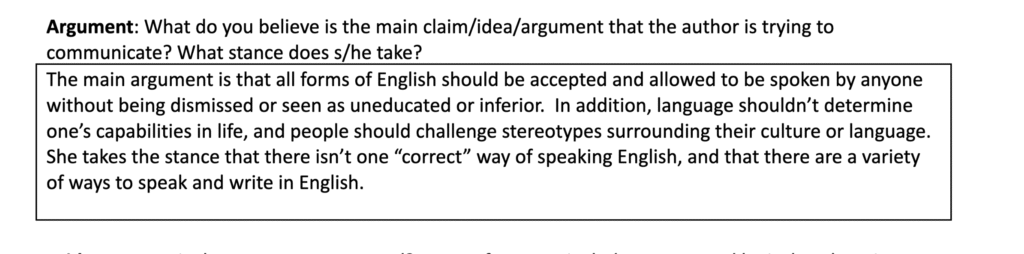
Rating: 4
Learning objective #2: To explore and analyze in writing and reading a variety of genres and rhetorical situations.
My paraphrase: Taking time to closely read and annotate different genres of texts that were given to us in class, and interpret the meaning or message that the author is trying to send.
Evidence: I demonstrated this by completing the rhetorical situation worksheet for each course reading. I would analyze the text for its purpose, examine the audience and the author’s intentions, and the use of evidence to support their claim.
“This author is trying to inform that allowing the use of different forms of English is beneficial to writers and all forms of communication in academic, workplace, and home settings. He is also trying to inform that writing in any form of English should be acceptable, and we shouldn’t only teach standard English to students or people.” (purpose section for “Should writers use their own English”)
Rating: 4
Learning objective #3: Develop strategies for reading, drafting, collaborating, revising, and editing.
My paraphrase: To me, this means learning different techniques and styles in writing, working with others to gain feedback, and re-reading your work to ensure you are getting your message across properly.
Evidence: I demonstrated this by reviewing previous works from other students and using the feedback I got from my peers to improve my work when writing my LLN essay. For example, I got feedback saying to be more descriptive with the setting of my narrative, and I added more details on how the classroom looked, how big it was, and how I felt when I was physically in the classroom.
“There was a whiteboard and a projector screen at the front of the room, where we would present our work. The large class was decorated with colorful flags, plastered with those “elementary” style posters containing the basics of Spanish. They were meant to help, but all they did was mock and intimidate me.”
Rating: 4
Learning objective #4: Recognize and practice key rhetorical terms and strategies when engaged in writing situations.
My paraphrase: This means being able to highlight rhetorical situations while reading a piece of literature and applying these strategies to your work to fulfill a specific purpose or engage with a certain audience.
Evidence: I demonstrated this by using the rhetorical worksheet to help guide my writing when I wanted to address a specific rhetorical strategy. For example, when I was writing my synthesis essay, I knew I was addressing medical professionals, so I made sure to write in a formal tone and use statistics to further solidify my claims.
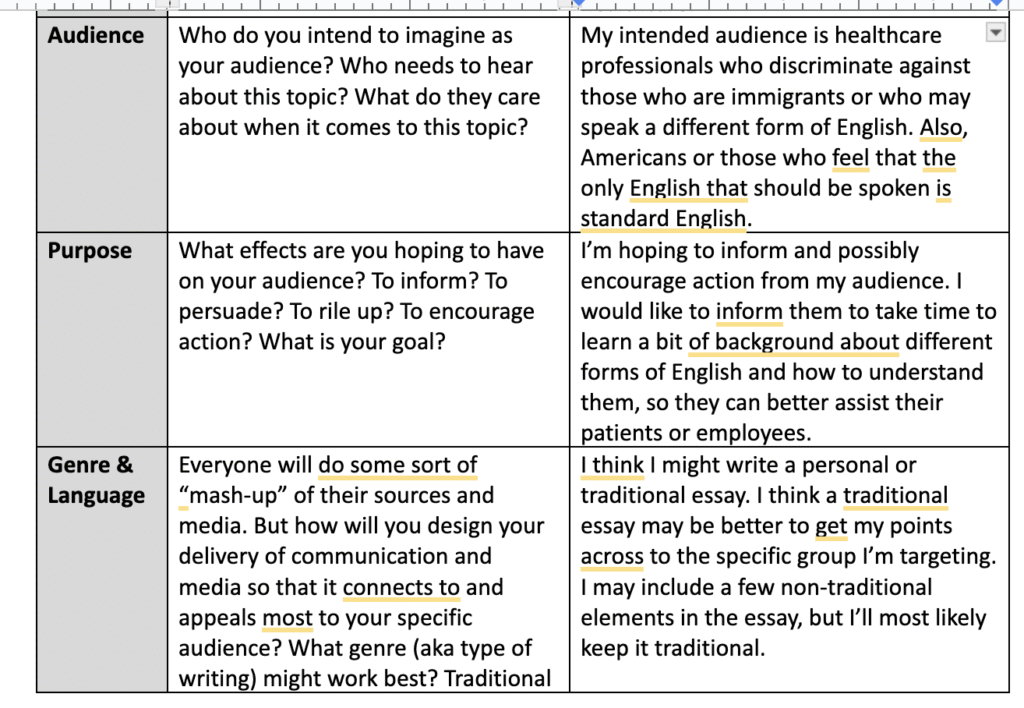
Rating: 4
Learning objective #5: Understand and use print and digital technologies to address a range of audiences.
My paraphrase: This means learning how to create a variety of art mediums like posters, poems, videos, etc and either using online resources or print and tailoring the content to best reach your audience.
Evidence: I demonstrated this by using online resources like Google Docs and Canvas to create a poem and posters for my translation 1 and 2 assignments. For example, I created a poster to go with my synthesis essay that illustrates a situation where a medical professional is having trouble understanding her patient. So I put a statistic and a few ways to help the medical professional better handle these situations to provide the proper care for their patients.
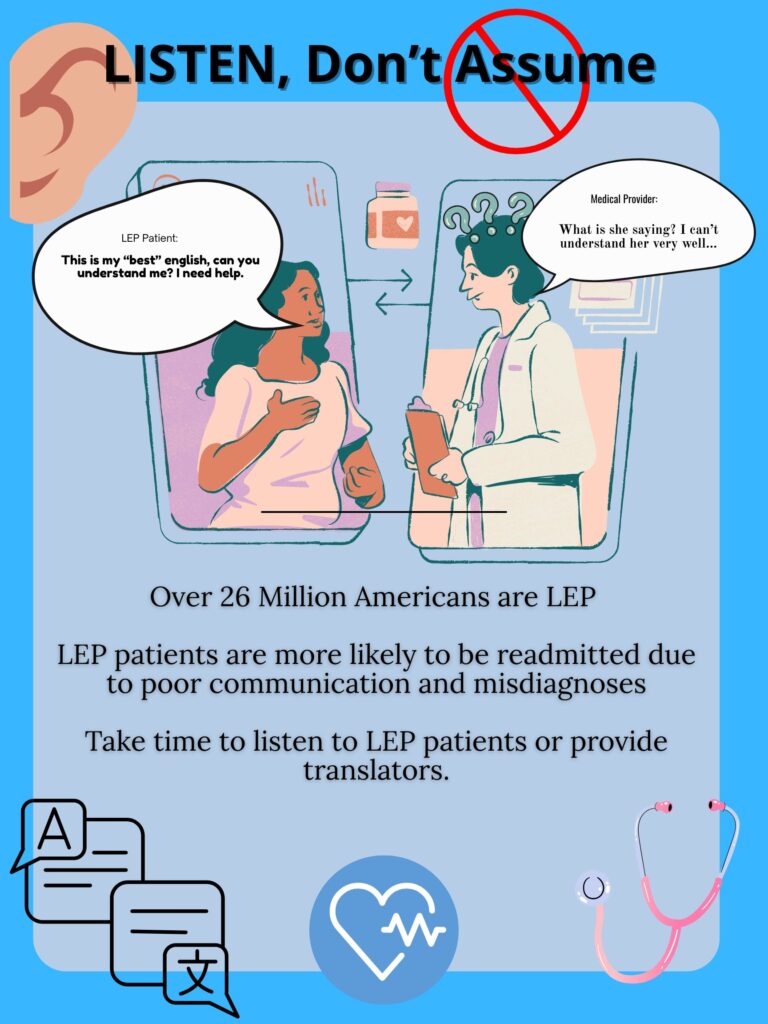
Rating: 5
Learning objective #6: Locate research sources and evaluate them for accuracy, bias, credibility, and timeliness.
My paraphrase: This means using online databases like CCNY libraries, Google Scholar, and Google to read them carefully to ensure that they are providing accurate and credible information, as well as ensuring they don’t have bias to support or add an opposing view to your work.
Evidence: I demonstrated this by doing research using CCNY libraries and Google Scholar to find pieces of evidence that were relevant to my topic. For instance, I would use CCNY libraries’ search engine and use specific keywords like language discrimination in healthcare, minority groups, and unequal treatment to help me find documents like peer-reviewed articles.
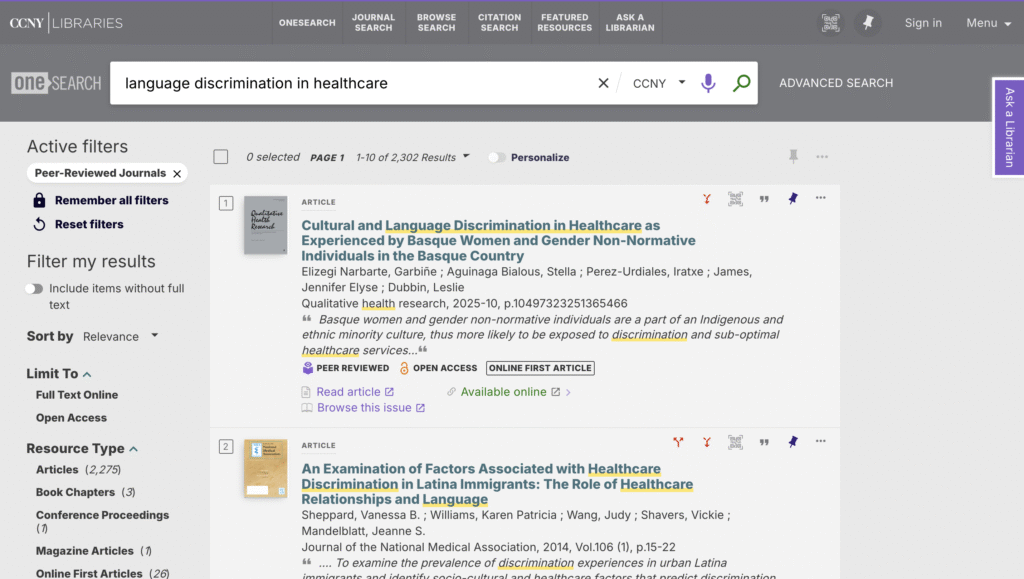
Rating:5
Learning Objective #7: Compose texts that integrate a stance with the proper sources using strategies like summary, analysis, synthesis, and argumentation.
My paraphrase: This means writing an essay that focuses on a specific topic and using the sources found to integrate different views to reach your audience.
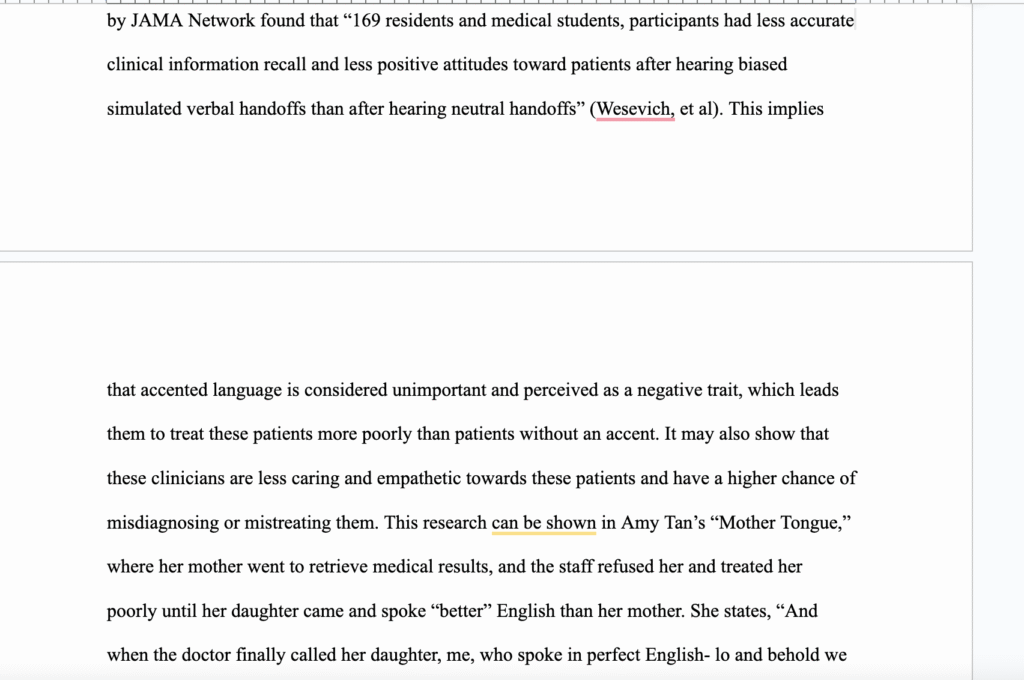
I demonstrated this by brainstorming and writing the synthesis essay, where I had to use 5 sources to support or contrast my claims. For example, here I used a research article and a personal narrative to support my claim.
Rating: 4
Learning objective #8: Practice systematic application of citation conventions.
My paraphrase: This means properly citing the sources you use by using MLA or APA formats and giving all sources you use credit, so you aren’t plagiarizing their work.
I demonstrated this by using different sites like EasyBib to cite the sources and documents I used in my synthesis essay, and ensuring each source was correctly cited using in-text citations and creating a reference page. For example, when citing a peer review article, I made sure to use in-text citations and create a work cited page with all the sources I used in order, and made sure that I gave each source credit.
Tan, Amy. “Mother Tongue.” The Threepenny Review, 1990, pp. 315–320. Chung, Eunice. “The United States Needs More Medical Interpreters.” Think Global Health, 2025, www.thinkglobalhealth.org/article/united-states-needs-more-medical-interpreters.
Rating: 5

This entry is licensed under a Creative Commons Attribution-NonCommercial-ShareAlike 4.0 International license.

